Why we should all be actively hopeful
Let’s start with some basic definitions.
Optimism is the belief that things will be better.
Pessimism is the belief that things will be worse.
Hope is the belief that things can be better (grounded in the clear recognition of our agency and the fact that this possibility is the result of near infinite inter-connected variables).
Active hope is acting positively based on the belief that things can be better.
Here’s a visual that grounds this a little.
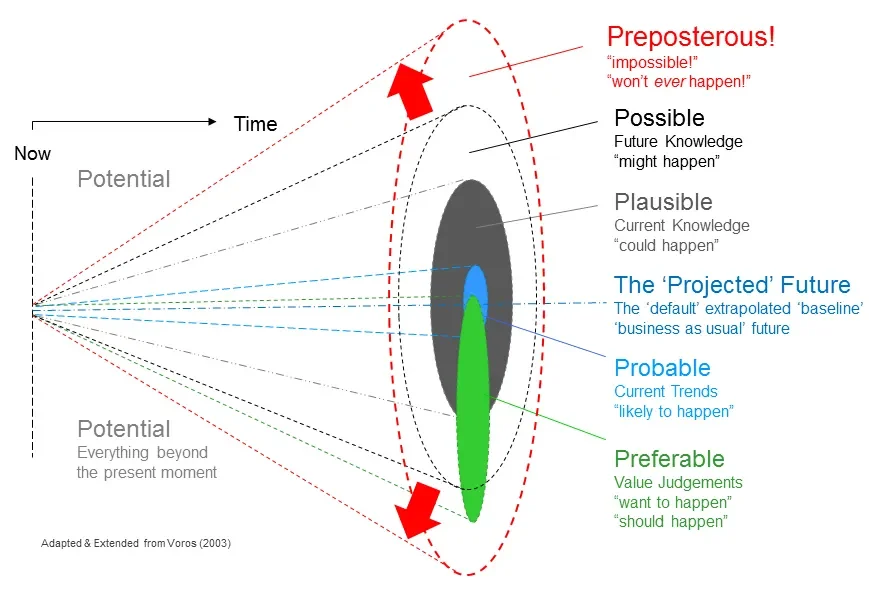
What we’re claiming is pretty simple. Things can always be better. Even if the likelihood of them becoming better is really, really low. And even if genuine, authentic betterment takes a very long time and is riddled with near unimaginable difficulty. They can be better.
What we have known intuitively for millennia, and what there is now some level of meaningful scientific evidence to support, is that when we anticipate something to be true (or we believe in certain ‘truths’ because they have been passed down to us in the through what Paul Musso PhD call’s your ‘birth view’; essentially the worldview you unknowingly inherit through being born into, then inhabiting, a particular context) we act in certain ways aligned to those beliefs. That action then increases the likelihood of the thing itself happening (often referred to as a self-fulfilling prophecy).
But there’s some nuance to this.
If you start out believing things will be better, you can fall victim to naive optimism biases that result in all kinds of self-deception and foolishness. The ‘Techno-Optimist Manifesto’ is a clear example of that.
If you start out believing things will be worse, you can fall victim to naive negativity biases that result in all kinds of self-deception and foolishness. This is basically a form of defeatism that can result in you retreating from your unique and meaningful participation in the world.
If you start out believing things can be better, yet ground your sense of compatible possibilities (compossibility) in a clear eyed view of past, present and future trajectories, you increase the likelihood you act in ways that give rise to some kind of meaningful betterment. You deepen your relation to reality, rather than bypassing it in some way, shape or form.
Using these definitions, and given what we know about the nature of the human organism and the structure of reality (and no, reality does not seem to be strongly deterministic in the sense that the future is ‘pre-ordained’, even though the universe does appear to be deterministic in the sense that everything has a complex causal structure), active hope is really the only viable stance to take.
Active hope orients us towards the ways in which things can be changed for the better. Active hope respects our agency. Active hope encourages us to work better, together, in service of compatible possibilites we would be proud to participate in.
This is why we should all be actively hopeful.
And that’s exactly what Philosophía Counselling can support (if that’s of interest to you. Philosophía Counselling does not prescribe a normative direction or promote a particular constellation of philosophical ideas. That is up to you).
If you’re interested, please consider booking a free 15 minute consult.
With φιλία (philía),
Nate